Follow UCreateChange on Facebook Follow UCreateChange on Twitter Subscribe to Engineering to inspire... RSS feed Got a question? Email us
0

Featured Video: Exhibition Pixel Park

Oh my…interactive art, sound and light sculptures, electronic foosball… technology used in art at the SuperUber World in Aug 2009.

Sound and light sculpture, musical sand, super pong, multitouch screen, blow, electronic grafitti and interactive mirrors. These and other interactive installations that are part of SuperUber's world, were shown at the exhibition Pixel Park: SuperUber Art and Technology in São Paulo, in august 2009.

Like this video?
Subscribe to UCreateChange’s YouTube Channel!
0

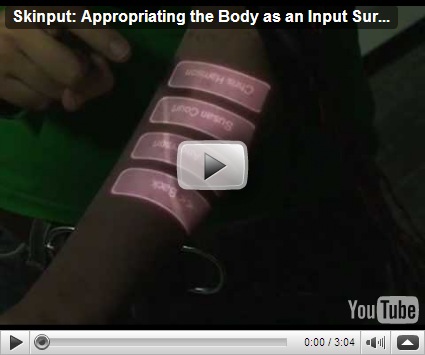
Featured Video: Skinput – body as touchscreen

Chris Henderson thinks we can use our skin as a touchscreen for our phones (or other mobile devices). We’re all canvases for the machine. But if it means doing away with bulky smartphones and easy-to-crack LCD screens, its got my vote (and $$$)!

Skinput, a technology that appropriates the human body for acoustic transmission, allowing the skin to be used as a finger input surface. In particular, we resolve the location of finger taps on the arm and hand by analyzing mechanical vibrations that propagate through the body. We collect these signals using a novel array of sensors worn as an armband.

Like this video?
Subscribe to UCreateChange’s YouTube Channel!

0

Last week in UCreateChange: Films & entertainment

18-24 Jan 2010

2010_01_25 - weekly roundup The Avatar and 3D entertainment craze certainly swept us into the world of red and blue and fuzzy lines that made images pop out from the screen.

And home film buffs can now do it to the tune of $21,000. Panasonic’s 3D camcorder is the first to combine 3D lenses into one easy to carry unit. We say wait a bit, it’ll get smaller, faster, and cheaper.

0

3D films: Entertainment tech

Jake Sully from Avatar So James Cameron’s Avatar bagged the best director and best movie at the Golden Globe Awards. It’ll probably go on to win a few more Oscars, but what it showed us was that films and entertainment are about to get truly interactive.

Remember The Matrix bullet time dodge scene (aka “Trinity, Help!”)? Known as the bullet time effect, it allowed “the viewer to explore a moment progressing in slow-motion as the camera appears to orbit around the scene at normal speed” (from Wikipedia). To get that effect, The Wachowski Brothers used an array of cameras to capture a scene from different angles, stitched them up, and ran them through a computer that generated Neo’s viewpoints.

Related Posts with Thumbnails
 

Recent posts

Recent comments

Friends

About e

Change Champion e: editor of UCreateChange.comI'm the editor of UCreateChange. And I started this blog with the intention of putting up my past weekly roundups 'cause it's a shame they're simply disappearing into people's inboxes. Anyways, if you've a question on engineering, drop me a line at creators.of.tomorrow@gmail.com!