…Or four things that Robots can do better
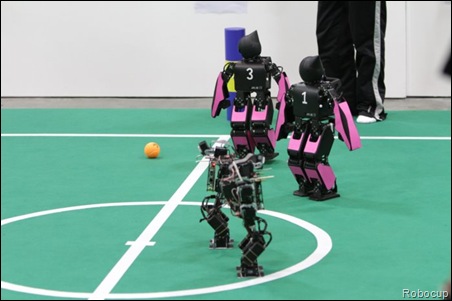
It’s Robocup week. That got us thinking about how zippy mechanoids kicking a little plastic ball could help us develop bigger and better zippy mechanoids.
Why?
‘Cause it’s hard to deny that robots are quite possibly the future. .
As Hans Moravec said in his article: Rise of the Robots --The Future of Artificial Intelligence in 2008…
“I am convinced that the decades-old dream of a useful, general-purpose autonomous robot will be realized in the not too distant future. By 2010 we will see mobile robots as big as people but with cognitive abilities similar in many respects to those of a lizard. The machines will be capable of carrying out simple chores, such as vacuuming, dusting, delivering packages and taking out the garbage.
“By 2040, I believe, we will finally achieve the original goal of robotics and a thematic mainstay of science fiction: a freely moving machine with the intellectual capabilities of a human being.”
It’s 2010 now, and Moravec’s simple robots with lizard-like cognition are appearing here and there. While 2040 is still a while away, we wondered what could robots do for us. So we brainstormed, thought and fought over civet cat coffee and came up with four ways that robots could be used in the future.
Do Dangerous Things
 Robots could be employed to do dangerous and repetitive jobs. Most often, you’ll see robots in Manufacturing where they “cut and shape fabricated parts, assemble machinery and inspect manufactured parts. Some types of jobs robots do: load bricks, die cast, drill, fasten, forge, make glass, grind, heat treat, load/unload machines, machine parts, handle parts, measure, monitor radiation, run nuts, sort parts, clean parts, profile objects, perform quality control, rivet, sand blast, change tools and weld.”
Or they’re used to investigate hazardous and dangerous environments such as the inside of a nuclear reactor. Just strap a robot with cutters, cameras, coreborers and sensors, and you’ve got a spy tin man (like The Pioneer robot).
Live Vicariously Through Them

Asimo is a robot created by Honda that responds to human thought. Right now, the technology only allows us to raise an arm or a leg, and you’ve to put on a helmet full of electrodes that are connected to a massive computer. It works by reading your brain’s electrical impulses and converting them into signals that the Asimo robot can understand. So think “raise hand and wave” and the robot will do so.
We’re also thinking of a certain bald action hero -- Bruce Willis, anyone?
Be Our Pets
 We’d be keeping robots as pets in the future. They don’t need cleaning up after or throw tantrums (unless their circuits are crossed), and they can do a lot of interesting things.
Like The Furby -- a Mogwai look-alike electronic pet that “starts out speaking entirely Furbish, the unique language that all Furbies use, but are programmed to speak less Furbish as they gradually start using English.” (from Wikipedia). This touched off a whole slew of robot pets that could do things that other pets couldn’t. Plus, they’re really huggable.
 Also we might begin to socially interact with human-like robots in the future.
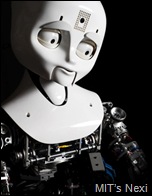
They could train us to handle awkward social situations or just provide companionship for humans, like MIT’s Nexi – a human-like robot that speaks and uses complex hand movements and facial gestures. Of now, the greatest stumbling block is believability, a robot still looks artificial (and creepy). But the Japanese have invented a robot that looks just like a human and acts like one too. Perhaps robot playmates will be hitting the store shelves soon?
Look Cool

‘nuff said…
What else could robots contribute? Leave it in the comments!
 Take the Create2011 engineering challenge and tell us your vision of Future Mobility to win the grand prize of: A Nokia Experiential Journey in Beijing and Singapore! Check out our Facebook fanpage for exciting contests & giveaways!


 I'm the editor of