Here’s a short video clip of Creator of Tomorrow, Gary Chan, talking about how the accelerometer in a handphone was used by the Makanstura folk to create an app that mimics how people actually use the book!
Wouldn’t it be nice?


Here’s a short video clip of Creator of Tomorrow, Gary Chan, talking about how the accelerometer in a handphone was used by the Makanstura folk to create an app that mimics how people actually use the book!
Wouldn’t it be nice?
You’ve got your idea. You’ve submitted it.
More importantly, you’re a Create2011 finalist!
So what next?
Apart from garnering votes (very, very important if you want to win that 4-day trip to Nokia Singapore and Beijing!), Create2011 finalists must create prototypes and present them to our judges!
That’s actually three different posts: one on garnering votes; another on prototypes (which our CoTs will be mentoring); and finally on presentation.
Last week, our guest writer Ong Yizhen wrote a rousing post on how to do up and present your idea to kick ass (like our favourite non super-powered hero).

But what would rock the Creators of Tomorrows’ boat? We’ve polled them for their responses and found that it’s a mixed bag of acting and tips.
Got a problem? Tell us at creators.of.tomorrow@gmail.com and we’ll help you out!

While compatriot Ian Pang works at LucasArts in California, Ho Wuiyee works at LucasArts Singapore. Besides location, his role is also somewhat different. His main role is to ““program and fix the graphical glitches and inconsistencies” as a software engineer.
Within the context of a game, he thinks it’s important to…
…find new ways to engage the player. It is a continuous learning process with new hardware being announced and interactive entertainment moving to new platforms in the form of handhelds and mobile phones. The processing and graphical capabilities of some of the latest handheld gadgets are simply mind blowing!
But really, he wished that someone had invented a time machine! Why? “I believe everybody at some point in time would have wished for the ability to travel backwards or forwards in time!”
As do we all.
Maddy Bandera’s a Lean Six Sigma Blackbelt at IBM.
No…Her black belt isn’t about beating people up. Rather it marks her as practitioner of Lean Six Sigma – a way of improving business processes.
And that’s what she does for IBM.
As a Black belt, I work with internal clients within IBM to address problem areas in the business by applying process improvements using the Lean Six Sigma (LSS) approach. Process improvement and standardization is important to any organisation because it ensures that it is operating at an optimal level, costs are kept down and customer satisfaction is met or even exceeded.
Interestingly Maddy didn’t envision herself as an engineer.
That changed when she enrolled into an Industrial Engineering course. It gave her a mix of Business and Engineering that she could parlay into a successful career.
It also allowed her to indulge in her wanderlust as she travels quite a bit for work. However she “loses track of what time zone I’m in”, but that’s a problem that we’d love to have, yes?
In a nutshell, it’s the science of making things work: how things or systems work together to achieve its intended purpose.
The thing I like most about this job is that it gives me the opportunity to have global exposure. Being in a global project, I work a lot with colleagues from various parts of the world and learn a lot culturally. This helps to broaden my view about the world and also improves my understanding of different cultures and practices.
In any situation, change is not easily accepted. I think one of the best approaches would be to listen and understand where the resistance is coming from and be open to suggestions.
Also, you have to be able to communicate well the intent of any changes that would be introduced and assure them that it is for their and the organization’s benefit.
A little technology goes a really long way, from boatmen in remote parts of the world having access to the internet or mobile phones to help promote and manage their business, allowing tourists to book easily, to paperless boarding passes which use barcodes stored as images in your cellphone to make flight check-ins a breeze. These inventions make our lives easier and give us more time to dream of the next big invention.
Dare to dream and when you do, dream big. Don’t be afraid to learn and explore, nor fail. Because being good at something is really a process and starts with you deciding what you want to do and pursuing it. If you stumble along the way, don’t hesitate to start all over and ask for help.
|
|
You’ve got a bright idea for Create2011. So does your teammate.
Here’s the problem: you both think that your own idea’s better than the other… So how do you resolve it?
Or what if your teammate isn’t doing any work?
Or what if you just don’t have the time to work together?
They are problems that every team will face. In fact, you might just be having a teamwork crisis right now! But working in teams is a big part of doing engineering. In fact, engineering projects are just too large-scale for anyone to do on their own.
While we realise there might problems, just talking about it doesn’t solve it. That’s why we got the Creators of Tomorrow to weigh in on how to work better as a team.
Got a problem? Tell us at creators.of.tomorrow@gmail.com and we’ll help you out!
It’s easy to know if we made it in school. Our report cards have A’s, B’s, C’s on them. Problem is: it gets thorny outside of school where standards (e.g. 90 marks = A) become somewhat fuzzy and arbitrary.
That includes the Create2011 Engineering Challenge.
We’re looking for “a brilliant idea related to the theme of Future Mobility, one which can improve the way we play, think, live and connect.”
But how do we know if our ideas are “brilliant”?
The judges will tell us…if we make it to the finals. But we’ll need some way of deciding before then; to see if we’re “on track” or not.
So for this instalment of the Create2011 Help Files, the Creators of Tomorrow tell us what they think makes a brilliant idea.
Note: These are some ways to help you judge if your ideas are good. Tell us what you think about them in the comments…

Here’s something even better: making this dream come true for millions of fans and gamers around the world.
Ian Pang, Associate Producer at LucasArts in California, does it on a daily basis. To him,
“Games are about fulfilling dreams and fantasies. If you want to feel like a Paladin, a Fighter Pilot or a Jedi, playing video games can bring that experience to you. Not many careers allow you to touch lives all over the world the way game developers are able to.”
His next big ambition is to work with Shigeru Miyamoto, a man who has made some of Ian’s favourite games and never fails to amaze him with his designs. Give him a shout-out if you can make his dream come true!
In the meantime, Ian tells us more about what goes on behind the games…

We can read minds. You’re probably thinking: “most engineers are guys, it’s all about maths and science, and it’s about ‘nerdy males who design weaponry in the movies’.”
Hrmmph. Have you met Sung Peir Fen?
Woman, process engineer at ExxonMobil, and interviewed on 938Live in December 2009.
And you know what? Peir Fen’s just as sceptical when we spoke about perceived limitations for women engineers:
“Contrary to public perception, there are many female engineers in the petrochemical industry. In ExxonMobil, there are numerous women role models in management positions, for younger engineers like myself. They hold key posts in technical, operations, engineering, logistics and even construction management.”
If you think that she sits in a cubicle all day long… think again, because she…we’ll let her tell you about it herself.
One last bite – Steve Jobs, if you’re reading this post, Peir Fen would like to invite you to dinner ‘cause you are “innovative and constantly challenging norms”.

“I don’t know. Just google it.”
Now look up “ornithopter” without using a search engine. Hard isn’t it? That’s why we’re thankful for search engines like Google, and Google’s thankful to its engineers.
Engineers like Andrew McGlinchey, product manager at Google, who:
“Causes Googley things to happen in Southeast Asia. I am the bridge between the software engineering teams and the users, as well as the other parts of Google (like marketing, business development, and marketing). I figure out what the products should be and work with the engineering team to make that happen.”
This is Andrew’s second appearance on our blog (read his five things to know about engineering). This time it’s all about him and his views on engineering.
Before we let him loose, if you’re “right now in a university dorm room, or a garage or somewhere, creating the next amazing innovation that we’ll all be using five years from now” drop Andrew a line ‘cause he would love to be in your shoes.

My research for this week’s posts on Asian inventions and Asian inventors at UCreateChange.com turned up an amazing revelation: Singaporeans are as inventive as Koreans, Japanese, or Silicon Valley types.
A little history, we have plenty of firsts – Sim Wong Hoo for PC sound cards (to better listen to MP3), Trek Technology for thumbdrives (to better carry data around), and X-mini for mini subwoofers (to better blast emo-punk music).
We know them cause they made it to the top. So are there inventors who aren’t on our collective Wikipedia entry?
Hell, yeah.
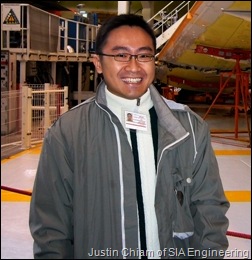
Well… Not literally, but he is part of the team that oversees the redelivery of aircraft that goes to SIA Engineering for servicing (located within Changi Airport).
He describes his work as:
“I look at continuous improvements of our operational processes. In the aviation industry, everything is highly regulated. Operational tasks must be carried out smoothly, efficiently and with clockwise precision. This is only possible if the SIA Engineering improves the efficiency and effectiveness of their processes. At the moment, my section looks at the running of aircraft maintenance checks – from start of negotiations until redelivery of aircraft to our customers.”
But we’re after more, so we asked:
Yes yes, we know that the spiel’s on UCreatechange.com.
But really, who is a Creator of Tomorrow (or CoT)?
Let’s count their characteristics:
But other than those bits, we don’t really know them.
Or why they’re CoTs for the matter.
So we had tea with them and talked and talked and talked. And we found a bunch of interesting things to share with y’all. That’s how we came up with the “Just Who is” series where every month, we’ll post up our talks with a different CoT… until we run out of CoTs. Hopefully, these interviews will give you insights to why these ordinary folk became engineers, and how they got to the top of their industries.
Now on to the first Creator of Tomorrow: Justin Chiam!

That discussion (right fine, it was an argument) got me thinking about the nature of engineering and what’s it about. Is engineering really just making stuff like cars, buildings and mp3 players? Is it a way of improving our lives? Or is it a way to view the world?
I figured that I’d might as well ask an engineer on it’s all about. Good thing that Creator of Tomorrow, Justin Chiam from SIA Engineering, stepped up to the plate and gave us an answer (or eight of them) to the “what’s it about?” question. Some of his answers, most of us would instinctively know. The rest perhaps, not so. But in all, it’s a good list to get a feel of how engineers see engineering.
In case you didn’t catch it, I was on 938Live Passion People. It was crazy cool talking about UCreateChange, innovation and engineering, as well as whether locals are creative (they are, you just don’t know it yet).
It’s a great first step at dispelling old-fashioned notions about engineering (and engineering folk).
And that’s what the Creators of Tomorrow are here -- to let people know that it’s a lot more fun, exciting and creative then the usual engineering myths. For this blog post, I’d like to expand on five engineering characteristics that I’ve mentioned in the interview* and give examples on what’s cool about them.
* FYI, my interview with 938Live is posted at the bottom. :)
We love coolness.
We pick the coolest handphones and the funkiest fashion; and for students in their final year of junior college – perhaps coolness is a factor when choosing a course and career.
But what’s cool as a course and career? Is it engineering, business or medicine or something else? Is “coolness” even a factor for students?
938Live’s radio show hosted by DJ Dave Martin at Anderson Junior College featured the topic “that probably factors into every student’s mind at one point or another – ‘what do I want to do with my life? How do I decide on a course of study?”’
And the responses from panelists and students, très interesting.

 I'm the editor of UCreateChange. And I started this blog with the intention of putting up my past weekly roundups 'cause it's a shame they're simply disappearing into people's inboxes. Anyways, if you've a question on engineering, drop me a line at creators.of.tomorrow@gmail.com!


